
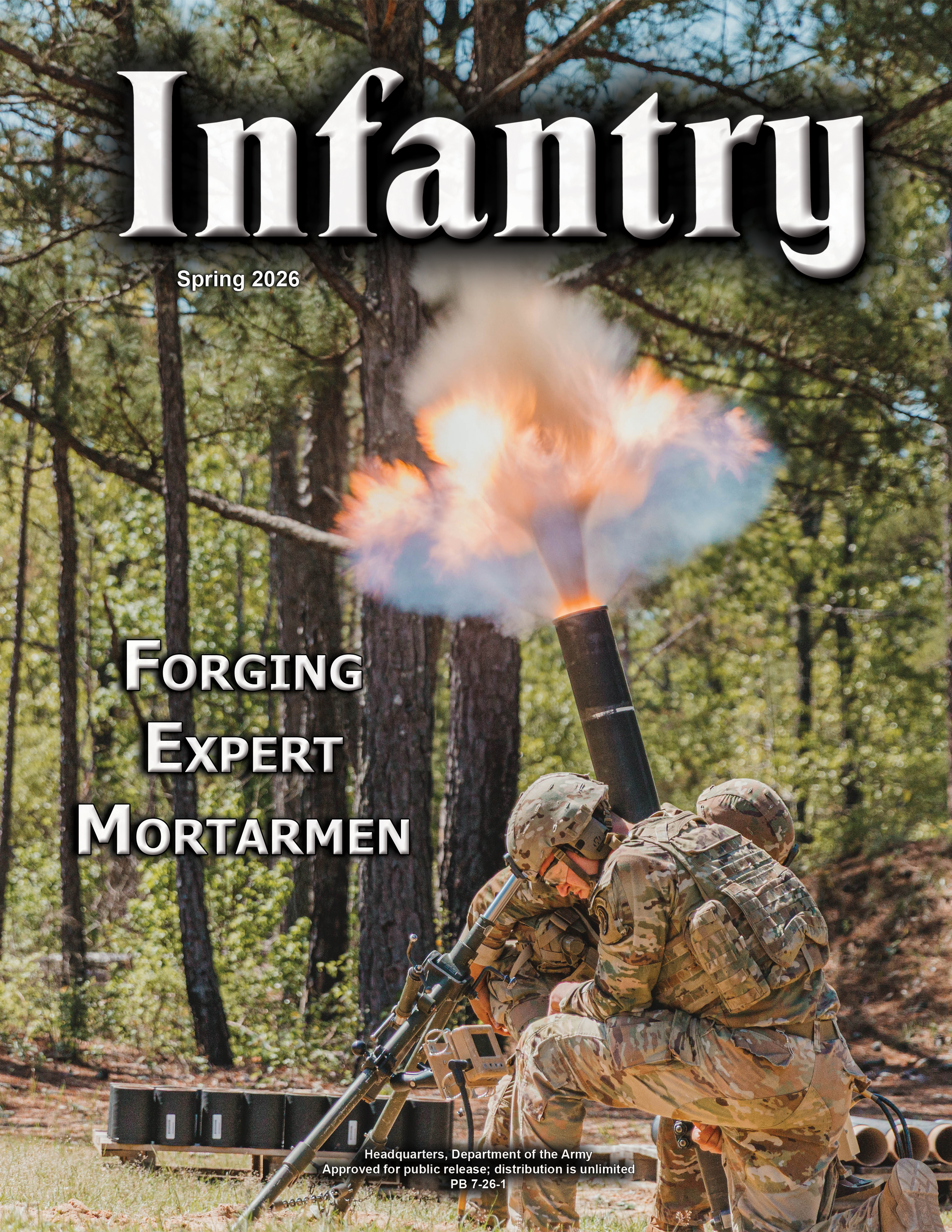
Spring 2026 Issue
Commandant's Note
Commandant’s Note Spring 2026
PDF Version
Brig. Gen. Phillip J. Kiniery
Features
The Importance of the Expert Infantryman Badge
Command Sgt. Maj. Christopher K. Donaldson
When I attended basic training in 1999, there was a quote painted on the walls of my barracks that I remember to this day and still holds true: “The EIB is the true mark of an Infantryman.” This is something that has stuck with me throughout my entire career. Over the last few months, the U.S. Army Infantry School (USAIS) hosted two Expert Infantryman Badge committee meetings with sergeants major from across the force to discuss potential updates to USAIS Pamphlet 350-6… .read more
A New Era for Mortarmen: Transformation of the Indirect Fire Infantryman Training Strategy
Sgt. 1st Class Jessie E. Lauritzen and Staff Sgt. Charles W. Pferrer
The world of the Infantryman is one of constant change, and the tools and techniques we use to dominate the battlefield must evolve to meet new threats. The recent release of the updated Training Circular (TC) 3-20.33, Training and Qualification of Mortars, marks a significant step forward in how the Army trains and certifies its mortar crews. This isn’t just a minor revision; it’s a comprehensive overhaul that will have a lasting impact on our indirect fire proficiency for years to come. So, what’s new, what’s different, and what does it mean for leaders and Soldiers in the field?...read more
Dark Horse of the Infantry: Reinvesting in the U.S. Army Mortarman
1st Sgt. Ryan D. Shaw
For over a century, mortarmen have been the Infantry’s quiet advantage — an organic, lethal, accurate, and responsive indirect-fire capability unmatched at the tactical level. They are the Infantry’s “dark horse:” a force with tremendous potential that — when properly managed, trained, and resourced — can shape the battlefield decisively. Yet today, I believe many formations underutilize and under develop this capability. This article seeks not to criticize units but highlight an opportunity....read more
Forging the Expert: Introducing the Infantry Master Mortar Trainer Course
Capt. Patrick M. Elsenbast and 1st Sgt. Ryan D. Shaw
In the crucible of modern combat, the familiar thud of a mortar leaving the tube is the sound of assurance for the Infantryman. It is the promise of immediate, responsive, and lethal indirect fire support, a critical enabler for freedom of maneuver. As the U.S. Army continues to orient on the complexities of multidomain operations (MDO), the need to guarantee the proficiency of our mortar formations has never been more acute. How can we continue to elevate mortar training to dominate contested environments?...read more
Eyes in the Sky: How IMLC Is Transforming and Integrating SUAS
Capt. Patrick M. Elsenbast
As the U.S. Army transitions toward large-scale combat operations and multidomain integration, the Infantry Mortar Leader Course (IMLC) is evolving to meet those demands of our force. Among the most significant advancements is the integration of small unmanned aerial systems (sUAS) into mortar operations — a capability that is reshaping how future leaders plan, direct, and deliver high-angle fires...read more
Innovation at the Speed of Relevance: Fielding Blast Overpressure Solutions Now
The 75th Ranger Regiment’s Brain Protection Task Force
For generations of mortarmen, headaches, tinnitus, and cognitive fog have been written off as the price of employing a devastating weapon system. These symptoms, often mirroring those of a traumatic brain injury (TBI), were accepted as an unavoidable cost of lethality. Now, the U.S. military is confronting the invisible cause behind them: blast overpressure (BOP). This silent threat, produced by the very weapons that ensure our dominance, represents a serious danger to warfighter health, particularly for communities in close proximity to high-caliber and explosive weapon systems...read more
*Online Exclusive* – Modern Problems Require Modern Mortars
Lt. Col. John Leisinger
The Army’s new mobile brigade combat team (MBCT) design embodies the imperative of transforming while in contact. Smaller, faster, and leaner than the legacy infantry brigade combat team (IBCT), the MBCT prioritizes dispersion, depth, speed, and layered lethality as the primary light formation for ground maneuver. A host of unmanned aerial systems — some currently fielding, some still in development — afford the MBCT an unprecedented degree of precision lethality and situational awareness at ranges previously accessible only to a division or higher. The capability that needs to catch up is mass, specifically the agile and responsive mass fires provided by organic mortar systems...read more
Professional Forum
The SUAS Master Trainer Course: Forging the Future of Ground Warfare
Sgt. 1st Class Derrick Guyton
Across the training areas of Fort Benning, GA, the future of warfare is taking shape. The Small Unmanned Aircraft System Master Trainer (SUAS-MT) Course is no longer just about flying drones — it is about transforming how the U.S. Army fights. By merging tactics with cutting-edge technology, the course ensures that systems like the RQ-28A, RQ-28B, and Purpose-Built Attritable Systems (PBAS) become decisive enablers in combat operations...read more
Lessons from a Stryker Company Executing a Dismounted KCTC Rotation
Capt. Matthew Colvard
TDuring training rotations at the Korea Combat Training Center (KCTC), much like those at the Joint Readiness Training Center (JRTC) and National Training Center (NTC), participants experience heightened pressure and stress that simulates a large-scale combat operations (LSCO) battlefield. The valuable lessons gained, whether through failures or successes, have lasting effects throughout an Army career and show the importance of the large collective training objective. KCTC stands out because its training environment combines aspects of both JRTC and NTC, featuring a compact area that restricts mounted maneuvers akin to JRTC but also offers significant terrain changes reminiscent of Death Valley at NTCs...read more
An Oft-Missed Opportunity: Providing Command and Control with Geronimo At JRTC
Lt. Col. Travis J. Stellfox
When tasked to provide opposing force (OPFOR) augmentation at the Joint Readiness Training Center (JRTC), the 2nd Battalion, 12th Infantry Regiment, 2nd Stryker Brigade Combat Team (SBCT), 4th Infantry Division, elected to deploy our battalion tactical command post (TAC) to augment command and control (C2) capabilities. In partnership with the 1st Battalion, 509th Parachute Infantry Regiment (PIR) and the Commander, Operations Group (COG), 2-12 IN was able to integrate into staff processes and receive live repetitions at providing command and control (C2) against a thinking peer force. This training provided significant benefits to the 2-12 IN battalion staff, Geronimo’s ability to replicate a realistic enemy, and the rotational force...read more
Redefining Lethality: Building Overmatch in the Mobile Brigade Combat Team
Maj. Austin Hultman
In today’s Army, “lethality” is everywhere — it’s the centerpiece of speeches, strategy papers, and training guidance. But ask 10 leaders what lethality means, and you’ll get 10 different answers. Most will say it’s about building lethal teams — teams that shoot, move, and communicate with precision. Yet the real question is simpler and more important: How do we create overmatch? Overmatch is the condition in which a force can impose its will on an adversary faster, more accurately, and with less risk to itself, producing decisive effects at the time and place of the commander’s choosing. Creating overmatch requires building lethal teams, mastering the fundamentals, and relentlessly institutionalizing integration and redundancy so formations can seize and sustain the initiative under stress...read more
Army Transformation: One Weekend A Month
Maj. Lacie Hutchins, Maj. Nicholas Bowers, Capt. Colleen A. Gargiulo, and Sgt. 1st Class Christian K. Kastrinakis
The brigade commander pointed at his boot. “The infantry moves on its feet,” he said. I had just been denied an insertion platform for my scout platoon. We simply did not have the vehicles available. By the time our scouts completed their infiltration and were “eyes on,” we would need to resupply and risk compromising our position. Even to a lieutenant beginning his first combat training center (CTC) rotation, the limitations of the dismounted infantry brigade seemed absurd. It took several days to move the brigade, even with external support. This was not the formation to win a large-scale combat operation (LSCO) fight. With the Army Transformation Initiative and the formation of the mobile brigade combat team (MBCT), infantry formations will now be lighter, more mobile, and more lethal...read more
A Training Framework for the Three-Block War: Preparing Army National Guard Units for Diverse Missions
Maj. Colin S. Davis
The Army National Guard (ARNG) faces unique challenges, balancing wartime mission-essential tasks (METs) with additional roles in civil disturbance (CD) and humanitarian assistance/disaster relief (HADR). These diverse missions align with the “three-block war” concept, introduced by U.S. Marine Corps Gen Charles C. Krulak in the 1990s.1 This article outlines a training framework to prepare National Guard units for these simultaneous demands, given a drill weekend to integrate attack and defense, civil disturbance, and HADR training. By leveraging doctrinal resources, urban training centers, and experiential learning, units can develop the agility to transition more seamlessly between mission sets...read more
Standards, Discipline, and Training: A Look Across Deployments and Positions
Command Sgt. Maj. Abraham Lewis, 1st Sgt. Jacob Morash, and 1st Sgt. Christopher Stone
Fort Drum, NY — home of the 10th Mountain Division — is a unique location that allows senior NCOs to develop and enhance their leadership skills in a deployed environment. It is a blessing for those of us who serve as first sergeants (1SGs), providing opportunities to sharpen our leadership knives against the steel of a high operating tempo (OPTEMPO) that is well known across the Army. There are fewer still who get to apply those skills again as a command sergeant major (CSM) within the same battalion. This article attempts to capture the experiences of two 1SGs and a CSM serving in the same battalion a few years apart...read more
*Online Exclusive* – AI-Enabled Predictive Analysis to Enhance Force Health Protection, Readiness, and Resilience
Dr. Anders Wallqvist and Dr. Jaques Reifman
Emerging artificial intelligence (AI) technologies and systems can be used to enhance U.S. Army Infantry Soldier capabilities and capacity when operating for prolonged periods of time in austere and resource-limited environments. The Defense Health Agency Medical Research and Development Command (MRDC) is working on developing such systems to address readiness and lethality in conditions infantry unit personnel typically encounter, such as exposure to extreme environmental conditions, biological or chemical warfare, and infectious diseases, often coupled with conditions that allow for little to no sleep…...read more
Infantry Warfighting Forum Wrap-Up
